
NIPT on the NHS or Private?
What the NHS gives you free, what a private NIPT test adds from 10 weeks, and how to decide whether paying is worth it for you. By Gina at Numi Scan Gosforth.
Quick Answer
You can get NIPT on the NHS, but only as a second step. Every pregnant woman in England is offered free screening for Down's, Edwards' and Patau's syndromes, usually the combined test at around 10 to 14 weeks. NIPT (non-invasive prenatal testing) is only offered on the NHS if that first test comes back higher chance.
Privately, you can have NIPT as your first test, from 10 weeks. It is more accurate than the combined test and raises far fewer false alarms, but it is still a screening test, not a diagnosis. For many parents the free NHS test is enough, and this guide is here to help you decide whether you are one of them.
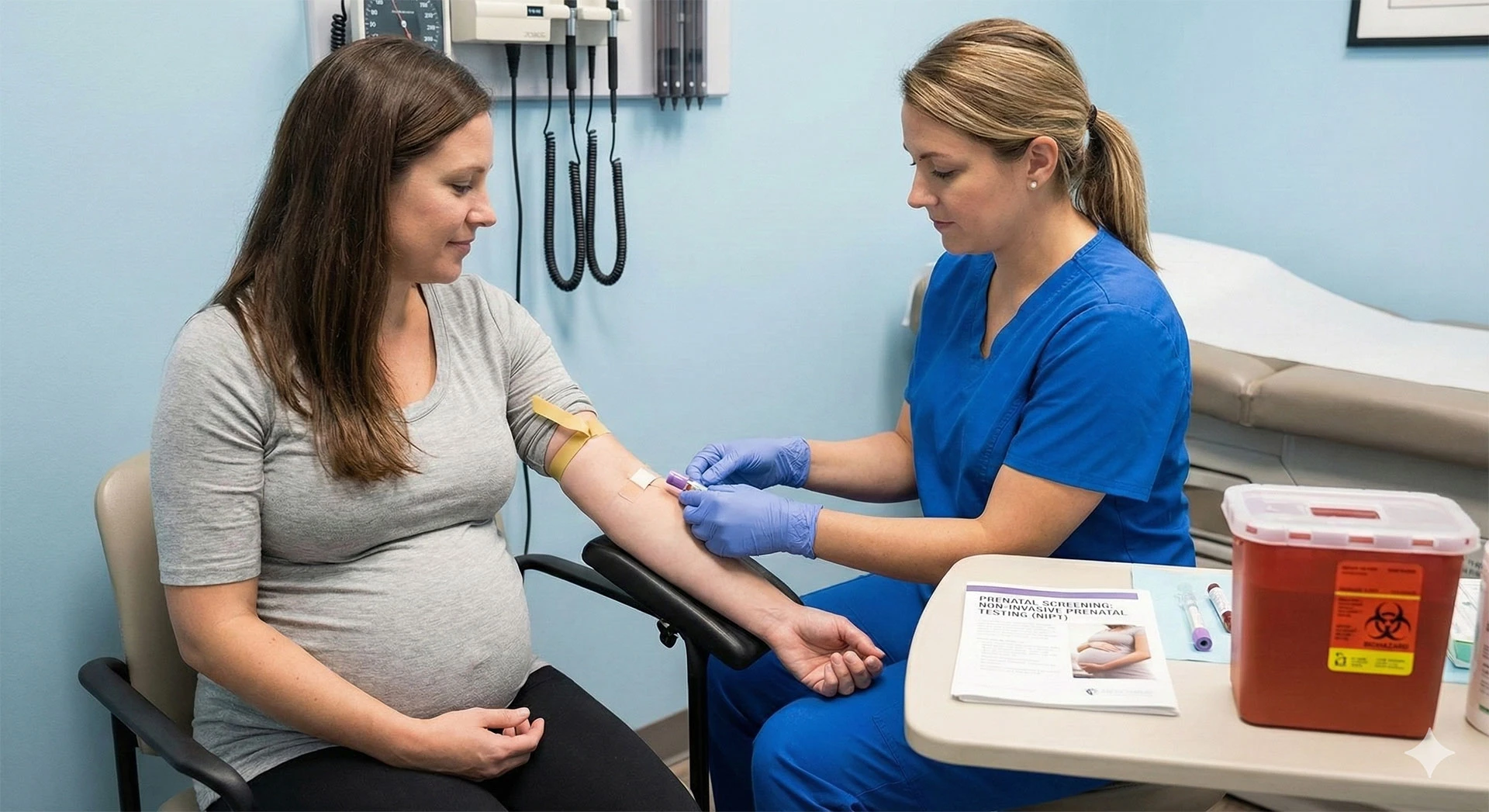
Can You Get NIPT on the NHS?
Yes, but not as a first test. Since 2021, NIPT has been part of the NHS screening pathway in England as a follow-up. If your combined or quadruple test gives a higher-chance result, you are offered a choice: NIPT, a diagnostic test, or no further testing.
You cannot ask for NIPT on the NHS instead of the combined test, and your age alone does not qualify you. The combined test already takes your age into account in the chance it gives you. If you want NIPT before your NHS screening, or instead of waiting for it, that is when people look at a private test.
What the NHS Combined Test Does
The combined test is the standard NHS screening for Down's syndrome, Edwards' syndrome and Patau's syndrome. It combines a blood test, taken between 10 and 14 weeks, with the nuchal translucency measurement from your dating scan at 11 to 14 weeks: a measurement of the small pocket of fluid at the back of your baby's neck.
The result is a chance, such as 1 in 1,000. The NHS aims to give you results within 2 weeks, and if yours is higher chance you will be contacted by phone or in person within a week. If you book too late for the combined test, you will be offered the quadruple test, a blood test between 14 and 20 weeks that screens for Down's syndrome only.
Every screening test in pregnancy is optional, which plenty of people don't realise.
What Private NIPT Adds
NIPT reads fragments of DNA from the placenta that circulate in your blood. Because it looks at chromosomes directly, rather than hormone levels and a measurement, it is much more precise than the combined test. You may also see it called the Harmony test, which is one brand of NIPT.
At Numi Scan Gosforth, NIPT comes in three tiers:
- Standard (£280): Down's (trisomy 21), Edwards' (trisomy 18) and Patau's (trisomy 13) syndromes
- Advance (£315): adds the sex chromosome conditions
- Absolute (£385): adds microdeletion conditions
The baby's sex can be reported too, if you would like to know. With an early pregnancy scan the tiers are £350, £400 and £480. Full details are on our NIPT test page.
The Two Tests Side by Side
| NHS combined test | Private NIPT | |
|---|---|---|
| When | Blood test 10 to 14 weeks, scan 11 to 14 weeks | From 10 weeks |
| How it works | Hormone blood test plus the nuchal translucency scan | Reads DNA from the placenta in your blood |
| Screens for | Down's, Edwards' and Patau's syndromes | The same three as standard; more on the Advance and Absolute tiers |
| False alarms | More common | Far fewer |
| Diagnostic? | No | No |
| Results | Within 2 weeks | 3 to 5 working days |
| Cost | Free | From £280 here; ARC puts the UK range at £350 to £550 |
How Accurate Is NIPT?
For Down's syndrome, NIPT detects more than 99% of cases. That is why NHS screening uses it as the follow-up test.
Two honest caveats. It is less reliable for Edwards' and Patau's syndromes than for Down's syndrome, as the charity Antenatal Results and Choices (ARC) points out. And it is not diagnostic: a higher-chance result can occasionally be wrong, usually because DNA from the placenta does not match the baby's. Only a diagnostic test can confirm it.
NIPT also only looks at chromosomes. It tells you nothing about heart conditions, spina bifida, growth or how your baby is developing physically. Those need ultrasound, and the NHS 20 week scan is the test for them. Nothing in this guide is a reason to miss it.
Why 10 Weeks, and Why We Recommend a Scan First
NIPT works from 10 weeks because before then there usually isn't enough of the baby's DNA in your blood for the lab to read. The proportion of DNA that comes from the pregnancy is called the fetal fraction. It tends to rise as pregnancy goes on, and is often lower in people with a higher body weight.
That makes your dates important. Counting from your last period assumes you ovulated on day 14, but irregular cycles and late ovulation are common, so a pregnancy dated as 10 weeks can really be 9 weeks or less. We advise confirming how far along you are with an ultrasound scan, not by your last period alone.
Ideally, have a scan before the blood test. It confirms the pregnancy is developing, that you have reached 10 weeks, and how many babies there are. That lowers the chance of an inconclusive result, although no scan can guarantee one. If you have already had a dating scan elsewhere and know your dates, the blood test on its own is fine. If you haven't, choose NIPT with an early pregnancy scan.
What Happens If There's No Result?
Sometimes the lab cannot give a result first time. ARC puts this at about 3% of tests. The commonest reason is that the sample was taken too early in pregnancy, before there is enough of the baby's DNA. Sadly, it can also happen because a pregnancy has stopped developing.
If the lab can't get a result because there isn't enough of the baby's DNA, or for a laboratory reason, the repeat blood draw is free. Our clinical team will contact you directly to arrange it and talk you through your options. Confirming your dates, and that the pregnancy is developing, before the first test is the best way to avoid needing one.
How Long Do NIPT Results Take?
Results usually come back within 3 to 5 working days of the sample reaching the lab.
Your sample is analysed by a specialist UK laboratory. ARC recommends asking any clinic which laboratory it uses before you book, and we are always happy to answer.
Can NIPT Tell You the Baby's Sex?
Yes, if you choose to know. NIPT can report the sex from 10 weeks alongside the screening. If you only want to know the sex and do not want screening, our Early Gender Blood Test works from 6 weeks, for £125. The same advice applies: confirm your dates, and that the pregnancy is developing, with a scan first.
If you would like to see it on screen too, a gender scan from 15 weeks can confirm it.
"My gender blood test was on Saturday and I've already received my results the following Tuesday afternoon!"
What If the Result Comes Back Higher Chance?
A higher-chance result does not mean your baby has the condition. It means a diagnostic test is needed to know for sure. The Royal College of Obstetricians and Gynaecologists is clear that decisions should not be made on a screening result alone.
What happens next is a referral straight to an NHS fetal medicine unit or a senior consultant obstetrician, rather than a routine antenatal clinic, so you have quick access to expert advice. There you are offered a detailed ultrasound scan and the choice of a diagnostic test for a definite answer. The same route applies if repeated samples still cannot give a result.
- Chorionic villus sampling (CVS): usually from around 11 to 14 weeks, testing a tiny sample of the placenta
- Amniocentesis: usually from around 15 weeks, testing a small sample of the fluid around the baby
Both carry a small risk of miscarriage, which is exactly why NIPT is so useful: far fewer people need one unnecessarily. Whatever the result and whatever you decide, Antenatal Results and Choices offers free, independent support on 020 7713 7486.
Is Private NIPT Worth It?
Most worthwhile if
- ✓Your NHS dating scan is still weeks away and waiting would be hard
- ✓A false alarm from the combined test would be especially distressing for you
- ✓You have had a previous pregnancy affected by a chromosomal condition
- ✓You want screening the NHS does not offer, such as sex chromosome conditions or microdeletions
- ✓You would like the baby's sex reported at the same time
The case for waiting
If your NHS scan is coming up soon and a lower-chance combined result would reassure you, a private test mostly buys you a few weeks of knowing sooner. Plenty of parents work that out and decide the NHS test is enough, and that's a good outcome.
Whatever you choose, keep your NHS dating scan and your 20 week scan. They check far more than a blood test can.
What to Check Before You Book Anywhere
ARC suggests asking every clinic these questions. Here is how we answer them.
1. Is a scan included or recommended first?
Yes. We recommend one and offer NIPT with an early pregnancy scan.2. Which laboratory processes the test?
A specialist UK laboratory.3. Is there a free redraw if there's no result?
Yes. A repeat blood draw is free if the lab cannot get a result.4. Is there a clear link to NHS care for a higher-chance result?
Yes. You are referred on to NHS fetal medicine care.5. Are results given in working or calendar days?
Working days: usually 3 to 5.6. Is the clinic CQC registered?
Yes. You can check us on the CQC website, and our CQC page has the details.
Our NIPT is £280 for the blood test on its own, with a £50 deposit that comes off the total on the day.
"The question I get asked most is whether it's worth paying for. If your NHS scan is soon and a low-chance result would settle your mind, waiting is completely reasonable. If you know the next few weeks would be spent worrying, ten weeks is a long time to hold your breath. Either way, let us scan you first so we know your dates are right."
NIPT at Our Gosforth Clinic
NIPT from 10 weeks, from £280, with the option of an early pregnancy scan first to confirm your dates. No GP referral needed.
Sources
- NHS: Screening for Down's syndrome, Edwards' syndrome and Patau's syndrome (test timings, results within 2 weeks, NIPT as a follow-up)
- Antenatal Results and Choices (ARC): NIPT explained (no-result rate, UK price range, what to ask before booking, helpline)
- Royal College of Obstetricians and Gynaecologists (screening results are not diagnostic)
- Numi Scan Gosforth clinical team (minimum gestation, scan-first advice, redraw and referral), October 2026
Frequently Asked Questions
Yes, but only as a follow-up. The NHS offers NIPT if your combined or quadruple test gives a higher-chance result. It is not offered as a first test.
No. Your age alone does not qualify you for NIPT on the NHS. Everyone is offered the combined test, which already takes your age into account.
It depends on how soon your NHS screening is and how you would feel while you wait. It is most worthwhile if your NHS scan is weeks away, a false alarm would be very hard for you, or you want screening the NHS does not offer. If your NHS scan is soon and a lower-chance result would reassure you, waiting is completely reasonable.
NIPT detects more than 99% of Down's syndrome cases, with far fewer false alarms than the combined test. It is less reliable for Edwards' and Patau's syndromes, and it is a screening test, so a higher-chance result needs a diagnostic test to confirm it.
Yes, from 10 weeks, if you choose to know. If you only want to know the sex, our Early Gender Blood Test works from 6 weeks.
Usually 3 to 5 working days at our clinic.
If the lab cannot get a result, usually because the sample was taken too early, the repeat blood draw is free and our clinical team will contact you to arrange it. A scan before the test, to confirm your dates, makes this less likely.
Yes. It is one blood sample from your arm. Unlike CVS or amniocentesis, there is no risk to the pregnancy.